Introduction to Programming – Complete Beginner's Guide
Learn what programming is, why it is important, different programming paradigms, and the various types of programming languages used in the software industry.
Introduction to Programming
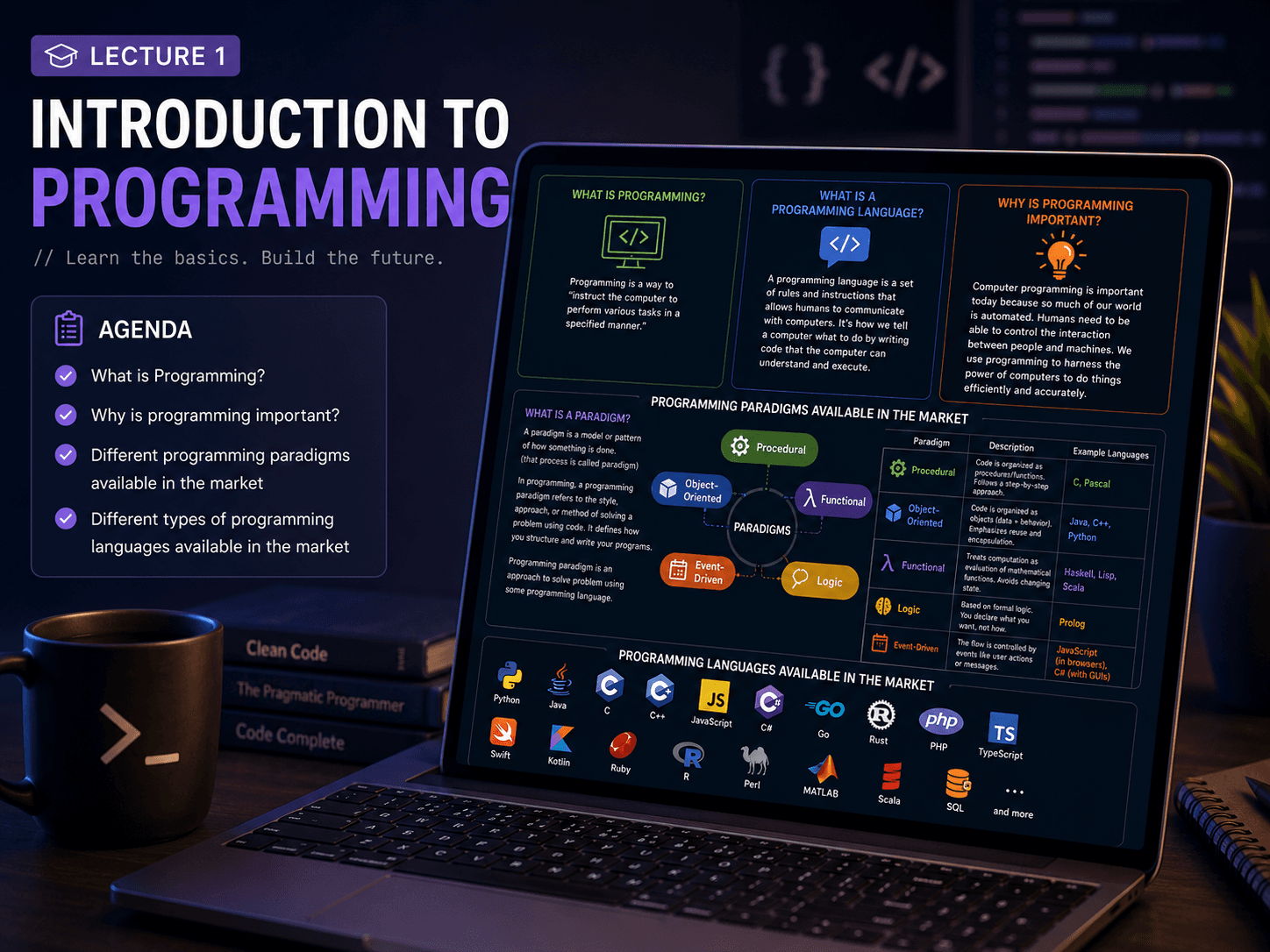
Agenda
- What is Programming?
- Why is programming important?
- Different programming paradigms available in the market
- Different types of programming languages available in the market
What is Programming?
Programming is a way to "instruct the computer to perform various tasks in a specified manner”
What is a Programming Language?
A programming language is a set of rules and instructions that allows humans to communicate with computers. It's how we tell a computer what to do by writing code that the computer can understand and execute. Think of it like a language we use to give instructions to a machine, similar to how we use natural languages to communicate with each other.
What programming is important?
Computer programming is important today because so much of our world is automated. Humans need to be able to control the interaction between people and machines. Since computers and machines are able to do things so efficiently and accurately, we use computer programming to harness that computing power.
Programming paradigms available in the market
What is a Paradigm?
A paradigm is a model or pattern of how something is done. (that process is called paradigm)
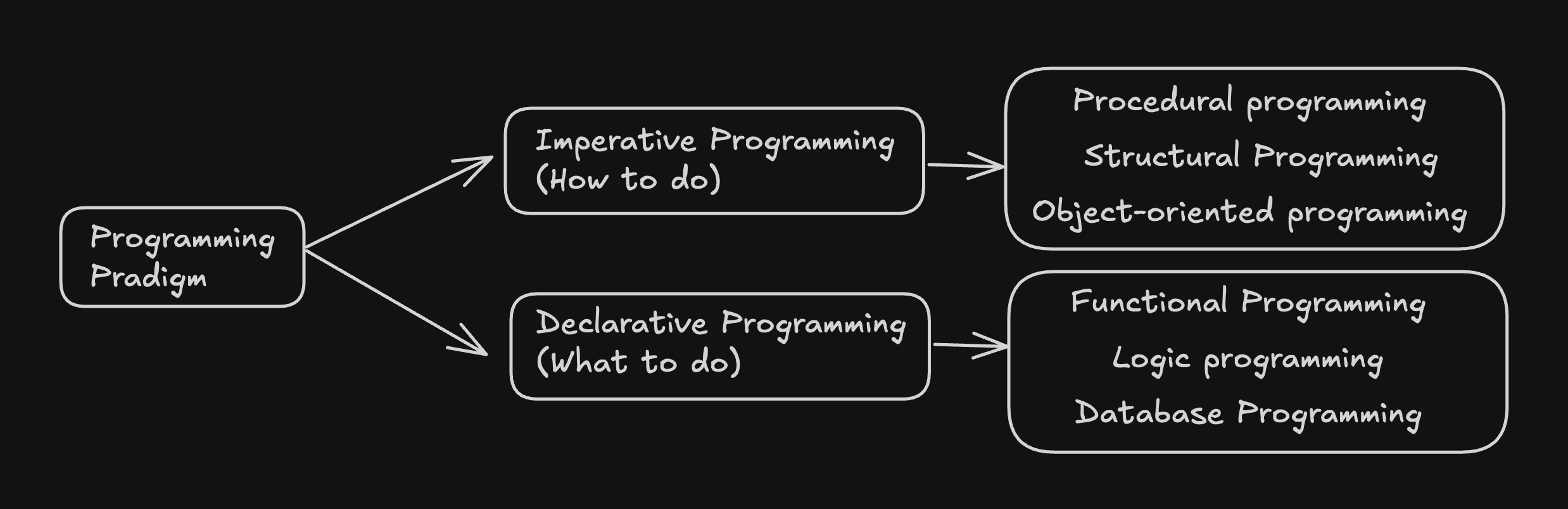
In programming, a programming paradigm refers to the style, approach, or method of solving a problem using code. It defines how you structure and write your programs.
You can think of a programming paradigm as a way of thinking about programming, or a set of rules and practices that guide how you write software.
Programming paradigm is an approach to solve problem using some programming language
| Paradigm | Description | Example Languages |
|---|---|---|
| Procedural | Code is organized as procedures/functions. Follows a step-by-step approach. | C, Pascal |
| Object-Oriented | Code is organized as objects (data + behavior). Emphasizes reuse and encapsulation. | Java, C++, Python |
| Functional | Treats computation as evaluation of mathematical functions. Avoids changing state. | Haskell, Lisp, Scala |
| Logic | Based on formal logic. You declare what you want, not how. | Prolog |
| Event-Driven | The flow is controlled by events like user actions or messages. | JavaScript (in browsers), C# (with GUIs) |
Programming languages available in the market